
A year ago, when colleagues in the industry discussed Europe’s energy storage landscape, the conversation almost always revolved around Germany, the UK, or Italy. Today, there is a new country that keeps coming up in my calls, my inbox, and my meetings: إسبانيا.
As someone who works in international BESS sales and speaks with developers, EPCs, and integrators across Europe every day, I make it my business to understand not just product specifications and pricing, but the deeper market forces at play — policy shifts, grid dynamics, electricity market design, and the commercial logic that drives investment decisions.
The more I dig into Spain, the more I am convinced that it is not just another emerging market. It is on the verge of becoming one of the most consequential energy storage stories in Europe.
What makes Spain different is that the urgency here is not theoretical. It has already been felt — in the most visceral way possible.

The Wake-Up Call: April 28, 2025
On April 28, 2025, at 12:33 PM, Spain and Portugal experienced the first full-scale blackout in the history of the Iberian power system. In five seconds, the grid lost approximately 15 GW of generation — roughly 60% of national demand. Over 50 million people were affected. Traffic ground to a halt in Madrid and Lisbon. Hospitals switched to backup generators. Mobile networks went silent. Power was not fully restored for up to 16 hours.
The economic impact was estimated at €2–5 billion. Nine lives were lost.
For months, speculation ran wild. Was it a cyberattack? A failure of renewables? A cascading equipment fault? When ENTSO-E published its final investigative report in March 2026, the answer was more complex — and more important — than any single-cause theory.
The blackout was a multifactorial overvoltage event. The system, running on approximately 80% solar and wind at the time, lacked sufficient dynamic voltage control capability. Oscillations had been visible since early morning. Key dispatchable units were offline. Renewable plants were operating in fixed power factor mode — meaning they could not dynamically support voltage when the system needed it most. And critically, battery energy storage capacity was far too limited to provide the fast, local grid services that could have stabilized the system.
As one analysis put it bluntly: “It’s not about renewables — it’s about voltage control.”
The lesson was clear. A power system with 70% renewables and almost no storage is not a completed energy transition. It is a system running without a safety net.
From Wake-Up Call to Market Inflection
The blackout did not create Spain’s storage market. But it accelerated what was already inevitable.
Spain’s energy transition has been remarkable by any measure. The country now has over 46 GW of installed solar PV capacity — the largest in Europe — with renewables accounting for roughly 70% of total installed capacity. In Q1 2026 alone, Spain added 2.3 GW of utility-scale solar, a 5.5% increase in a single quarter.
But this success has created its own problem — one that every high-renewables market eventually faces.
The Negative Price Epidemic
In 2024, Spain recorded 168 hours of negative wholesale electricity prices. In 2025, that figure surged to 555 hours — more than triple. By Q1 2026, Spain had already logged 397 hours of sub-zero pricing, compared to just 48 hours in the same period of 2025. In Q2 2025 alone, Spain recorded 411 negative-price hours — the highest of any EU-10 market.
Meanwhile, intraday price spreads have widened dramatically. Daily spreads between low and high-price hours now regularly exceed €150/MWh. On July 3, 2025, the retail electricity price spread in Spain reached €177.95/MWh.
This is the textbook signature of a grid saturated with solar: midday prices collapse to zero or below, while evening peak prices spike as solar generation disappears and demand surges. Solar capture prices in Spain fell 12% year-on-year to an average of €39.93/MWh in 2025, with monthly averages dipping below €20/MWh during peak solar months.
The message from the market is unmistakable: it is no longer about how much energy you produce — it is about when you produce it.
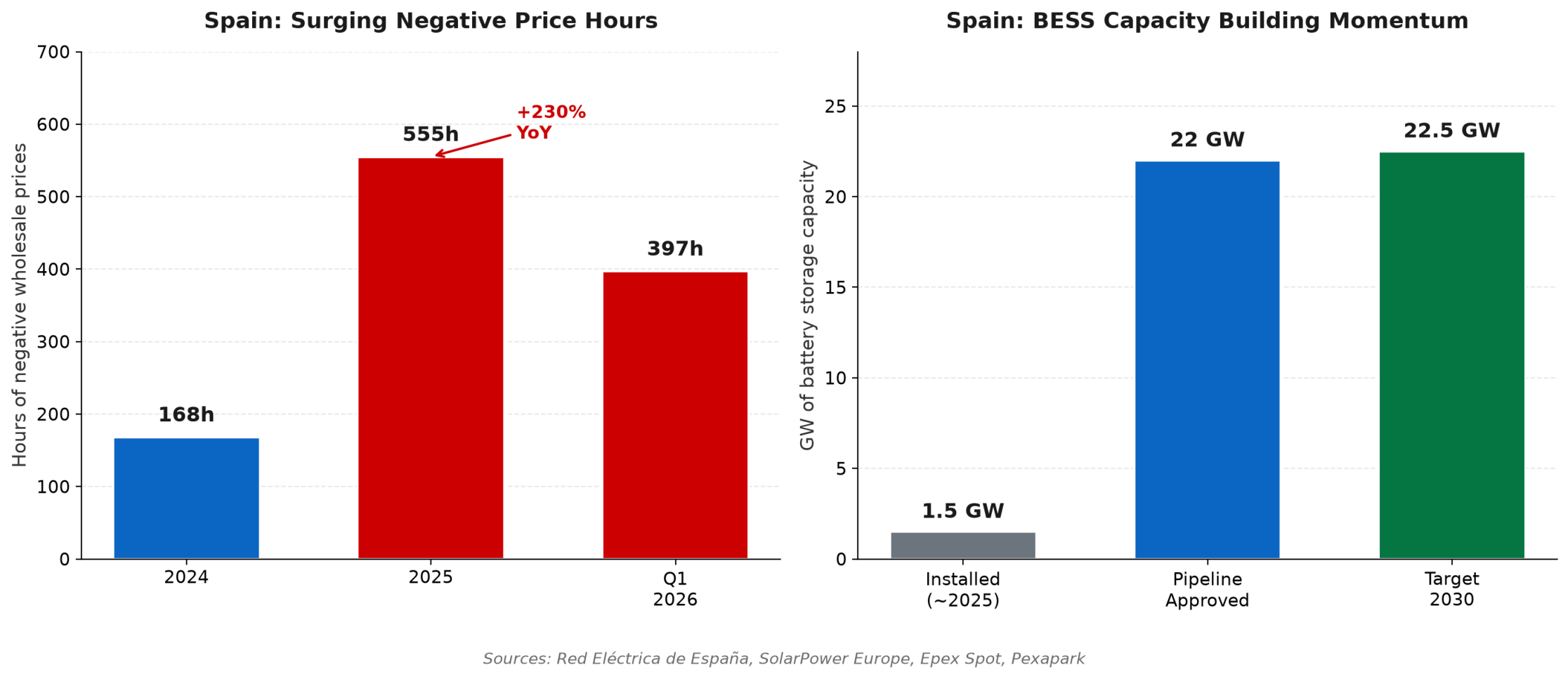
Spain’s Energy Market Shift: Rising Negative Prices and Growing BESS Demand
The Pipeline Explosion
Spain’s response to these challenges has been swift and substantial.
The BESS project pipeline has surged by an astonishing 464% year-on-year. Red Eléctrica has already approved 22 GW of storage grid connection permits, with an additional 16 GW pending approval. Over 25 GW of battery projects are now in the grid connection queue.
According to Spain’s National Integrated Energy and Climate Plan (PNIEC), the country targets 22.5 GW of energy storage by 2030 — a target that now looks not just ambitious but necessary.
Industry analysts project approximately 1 GWh of new storage installations in 2026 (a 233% year-on-year increase), rising to 2 GWh in 2027 and reaching 6.8 GWh by 2030.
And the projects are already moving:
- Naturgy broke ground on its first four BESS projects (160 MW / 342 MWh) in Almería and the Canary Islands, with a 10-project portfolio totaling €80 million in investment.
- Iberdrola commissioned Spain’s first large-scale batteries in January 2026 — Romeral and Olmedilla in Cuenca, each 30 MW / 60 MWh — as part of a 173 MW package backed by €37.5 million in PERTE funds.
- Grenergy is building the largest stand-alone BESS in Spain to date: the 150 MW / 600 MWh Oviedo project, with a 10-year financial tolling contract with an investment-grade utility.
- FRV is developing 334 MW / 1,336 MWh across six installations in Catalonia.
- Acciona, Statkraft, Galp, OPD Energy, Ignis, Zelestra, Engie, Repsol, and Endesa are all advancing substantial pipelines.
Zelestra, one of Spain’s leading developers, stated it plainly: “We don’t realize any PV solar project without any storage any longer. That’s a must.”
In fact, all 400 tracked contracted BESS deals in Spain in 2025 were co-located with solar — a clear signal that the market has internalized the logic of solar-plus-storage as the new default.
The Policy Tailwind
Policy is moving to catch up with market reality — and in some areas, ahead of it.
In May 2026, the European Commission formally approved Spain’s capacity market mechanism, which will mobilize up to €9 billion over 2026–2036 to ensure resource adequacy. This is a game-changer for storage, providing the long-term contracted revenue stream that transforms BESS from a merchant bet into a bankable infrastructure asset.
Beyond the capacity market, Spain’s storage push is supported by multiple funding streams:
- PERTE funds (EU Recovery and Resilience Facility) financing BESS capex
- FEDER-backed innovation auctions for energy storage
- The EU’s Energy Storage Strategy and the broader 200 GW EU-wide storage target for 2030
- The transition to 15-minute market time units (effective October 2025 across most European day-ahead markets), which has increased observable price volatility and widened arbitrage opportunities for storage operators
The structural shift to 15-minute granularity is particularly significant for Spain. The emergence of intra-hour “sawtooth” price patterns — driven by renewable ramping and grid constraints — has created additional arbitrage layers that simply did not exist under the old hourly settlement regime.
What Customers Are Really Asking For
Through my daily conversations with customers active in the Spanish market, I have noticed a clear evolution in what they need — and it goes well beyond hardware.
A year or two ago, the conversation was primarily about cell chemistry, system pricing, and delivery timelines. Today, the questions are fundamentally different:
- “Can your EMS optimize across multiple revenue streams — day-ahead arbitrage, ancillary services, capacity market obligations — simultaneously?”
- “Does your system comply with the latest Spanish grid codes and European regulations, including voltage support requirements?”
- “Can you support grid-forming capability? The blackout showed us that voltage control is no longer optional.”
- “What kind of commissioning and long-term O&M support can you provide locally?”
- “How do you handle co-location with existing solar assets? Our capture prices are collapsing without storage.”
These are not casual questions. They reflect a market that has moved past the “will storage work here?” phase and entered the “how do we make storage work optimally here?” phase.
This is exactly the shift I expected — and it mirrors what I have seen in other maturing European markets. Competition in the energy storage industry is no longer about whose battery costs less per kilowatt-hour. It is about who can deliver an integrated solution that creates long-term value across the entire project lifecycle.
For developers facing collapsing solar capture prices, the right storage partner is not just an equipment vendor. They need someone who understands the Spanish electricity market’s specific dynamics — the negative price patterns, the ancillary service revenue stacks, the capacity market framework, the permitting bottlenecks — and can design a system that monetizes all of them.
Connecting with Customers and Partners at The smarter E Europe 2026
Of course, every market has its own pace of development.
Spain is still an emerging market, where policies, business models, and electricity market mechanisms continue to evolve. But this is exactly what makes it so exciting. Its rapid growth is creating new opportunities for developers, EPC companies, investors, and solution providers.
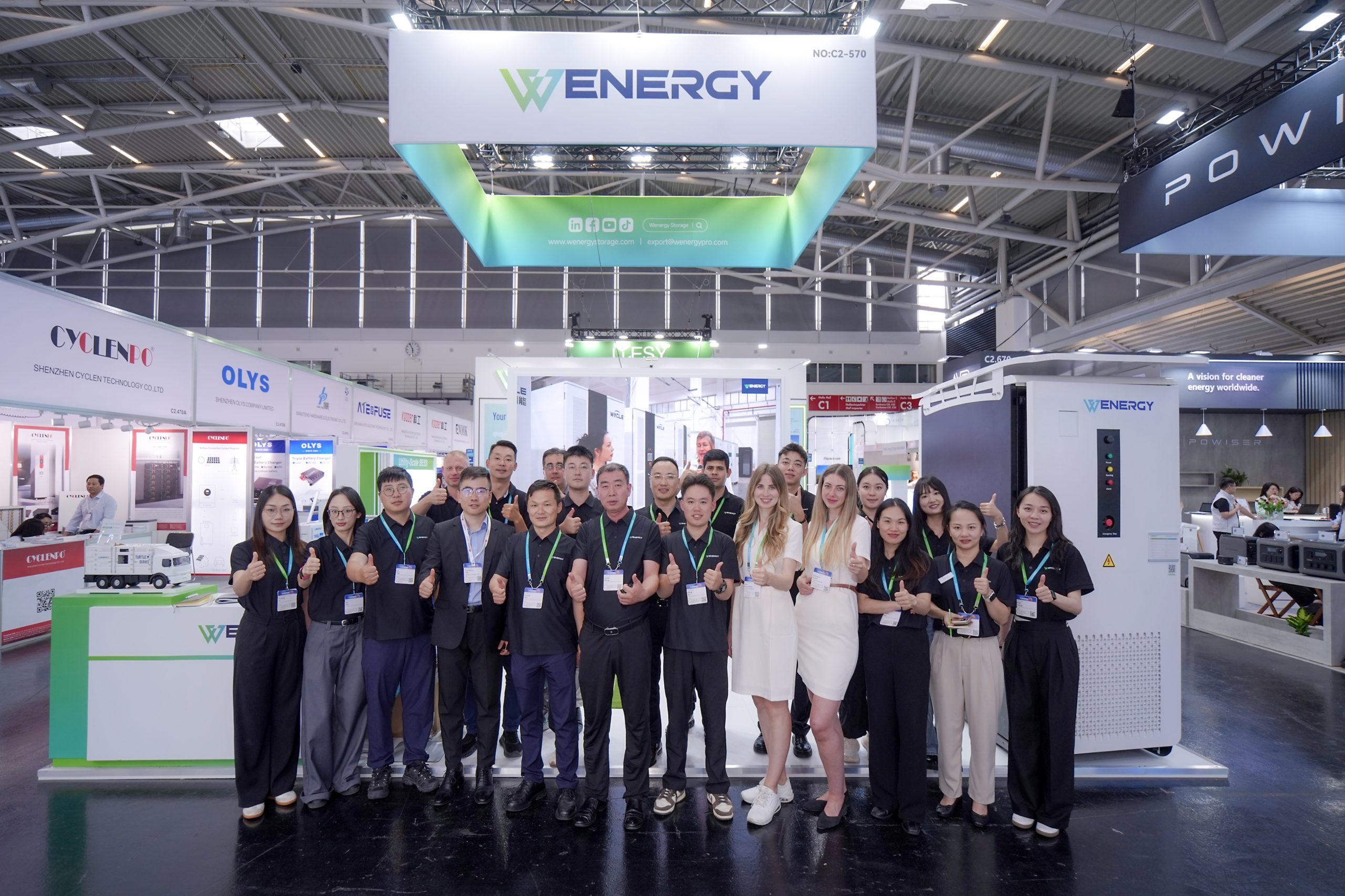
The Wenergy team at The smarter E Europe 2026
At The smarter E Europe 2026, conversations around Spain’s growing energy storage momentum continued to emerge.
For me, every market I research and every customer I connect with is a valuable learning experience. Each country has its own unique energy structure, regulatory framework, and customer expectations. The more I understand these differences, the better I can help customers find solutions that truly fit their specific needs.
نتطلع إلى الأمام
Spain is not without its challenges. Permitting remains slow — in H1 2025, 64% of BESS projects were stuck in environmental review or early-stage permitting, and not a single standalone storage project had received full construction approval. Grid connection queues are long. The regulatory framework, while improving, is still evolving. The capacity market details are still being finalized.
But these are the frictions of a market in rapid transition, not signs of stagnation. The underlying drivers — solar saturation, negative prices, grid stability imperatives, a €9 billion capacity market, and a 22.5 GW national target — are structural and irreversible.
Every market I study and every customer I engage with teaches me something new. Spain has taught me that energy storage is never just about batteries. It is about understanding the grid, reading the market signals, navigating the regulatory landscape, and building solutions that deliver value not just on day one, but across a 15- to 20-year asset lifecycle.
The April 2025 blackout was a tragedy and a warning. But the response — a 464% pipeline surge, a national capacity market, a wave of project announcements from every major Spanish utility — shows that the market heard the message loud and clear.
Spain’s energy storage story is just beginning. I look forward to continuing to learn from industry peers and working with partners across Europe to support the next stage of energy storage development.
About the author: The author works in international BESS sales at Wenergy, supporting EPCs, developers, and integrators across European markets with utility-scale and commercial & industrial energy storage solutions.
Key data sources: SolarPower Europe European Battery Market Outlook 2026–2030; ENTSO-E final investigative report on the Iberian blackout (March 2026); S&P Global; Red Eléctrica de España; Spanish Ministry for the Ecological Transition (MITECO); Pexapark; Bloomberg; Epex Spot.
Post time: Aug-10-2026